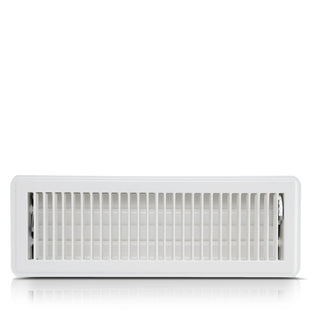
Floor registers deliver conditioned air from floor supply openings and include an adjustable damper to control airflow room by room. AirGrilles stocks steel floor registers, wood floor registers, and decorative floor vent covers in 5 colors, black, brown, gray, oak, and white, for replacement, remodel, and multi-room projects. Like other supply registers, floor registers are ordered by the duct opening size, offered in duct opening sizes from 2 inches to 14 inches, and the outer face runs about 2 inches larger than the opening. Bulk pricing covers 6 quantity tiers with savings up to 30%, orders of 500+ units qualify for custom production, and in-stock items ship the same day on orders placed by 11AM ET.
Choosing a Floor Register by Material and Style
The right floor register depends on the material, the color, and the style that matches the floor. Most replacement and new-build jobs use steel floor registers, which carry a powder-coated face that resists scuffs and corrosion under foot traffic. Wood floor registers in oak and brown tones match hardwood and warm-toned floors, while decorative floor registers add a patterned face for living spaces and entryways. Steel covers come in black, gray, and white, and the full lineup spans 5 colors across 2 materials, steel and wood. Match the material and color to the floor before checking the damper and the opening size.
Damper Control and Floor Strength
Floor registers differ from floor grilles by including an adjustable damper that opens, closes, or sets partway to balance heat and cooling room by room. The damper lever sits on the face or the side, so airflow drops in unused rooms without touching the thermostat. Floor registers also handle foot traffic and furniture, since steel models use a reinforced, powder-coated face and wood models are built for the same floor-level use with a finished look. The damper setting and the material strength both depend on getting the duct opening size right.
How to Measure and Match a Floor Register
To measure for a floor register, lift out the old register and measure the duct opening in the floor, not the outer frame of the old cover. Floor registers are ordered by that opening size like other supply registers, in widths of 2, 4, 6, 10, 12, and 14 inches and heights of 2, 3, 4, 6, 8, 10, 12, and 14 inches. The outer dimensions run about 2 inches larger than the opening in each direction, so a 2"W x 10"H opening uses a face near 3-3/4"W x 11-3/4"H that seats flush over the hole. With the right size confirmed, bulk pricing lowers the per-unit cost on whole-house and multi-room orders.
Bulk, Whole-House, and Custom Orders
Bulk pricing on floor registers drops the per-unit cost across 6 quantity tiers: 1, 2-10, 11-20, 21-49, 50+, and 100+, with savings up to 30% at the highest tiers. A typical steel floor register can drop close to 30% per unit from the single-unit rate to the 50+ tier. AirGrilles supports custom floor register production on orders of 500+ units, with the exact size, color, and lead time set per project. In-stock items ship the same day on orders placed by 11AM ET, so whole-house and property maintenance jobs stay on schedule.
Common Questions About Floor Registers
These answers cover the most common sizing, material, and ordering questions for floor registers and floor vent covers.
How do I measure for a floor register?
To measure for a floor register, measure the duct opening in the floor, the rectangular hole, not the old register's outer frame. Order that opening size, since the faceplate runs larger and overlaps the hole so it seats flush. A 2"W x 10"H opening, for example, uses a faceplate near 3-3/4"W x 11-3/4"H.
What is the difference between a floor register and a floor grille?
A floor register has an adjustable damper that opens and closes to control supply airflow. A floor grille usually has no damper and works for return air, the same way wall and ceiling return grilles pull air back to the system. Choose a register to control supply airflow, and a grille for return air.
Are floor registers strong enough to walk on?
Yes, floor registers are built to take foot traffic and furniture. Steel models use a powder-coated face that resists scuffs and corrosion, and wood and decorative styles are built for the same floor-level use with a finished look. Choose steel for the highest-traffic rooms like kitchens and hallways.
Which color should I choose?
You should choose the color by the floor and the nearby hardware, across 5 options: black, brown, gray, oak, and white. Black, gray, and white suit utility and standard spaces, while brown and oak match hardwood floors and wooden floor registers. Match the register color to the floor for the cleanest look.
Can I control the airflow?
Yes, floor registers include an adjustable damper you open, close, or set partway to balance heat and cooling room by room. The damper lever sits on the face or the side, so airflow adjusts without tools.
Do floor registers come in decorative styles?
Yes, floor registers come in decorative styles with patterned faces that replace plain covers. Browse decorative floor registers for patterned and ornamental steel faces that suit living spaces and entryways. Decorative styles use the same duct opening sizing as standard registers.
Can I request custom floor registers for a large project?
For 500+ units, AirGrilles supports custom floor register production on eligible products. Custom output is set by the size, color, quantity, and lead time, so larger projects confirm details before ordering.
Do you offer whole-house pricing?
Yes, bulk tiers apply automatically for multi-room and whole-house jobs, with savings up to 30% at higher quantities. In-stock items ship the same day on orders placed by 11AM ET.
What Amazon buyers said
A selection from across this range. Open a category to see all of its reviews.
4.9
based on 320 Amazon reviews across this range
Choosing a selection results in a full page refresh.
Order by the duct opening, not the faceplate. Remove the vent and measure the hole behind it, then order that size. Getting it right the first time means no returns, no reorders, and no waiting on the job.
Duct opening (remove vent, measure this hole)Faceplate (the part you see)